Approach
Sound designed for the whole room.
From the first plans, we draw the speakers into the joinery and aim the sound at every seat. Then we measure and tune each system in its own room, and adjust it to taste.
One chair or the whole room
One chair and everyone else.
Stereo has one ideal seat, so most serious systems angle their speakers in towards a single chair. The rest of the room hears them from the side. A speaker cone sends low notes wide and narrows as the pitch rises, so a guest on the sofa hears a different balance.
People share music at home, and they dance as much as they sit. The aim is the whole room, with the same balance of bass, middle and treble wherever they are. The ideal seat remains, with a very good zone around it. Pinpoint stereo everywhere is physically impossible, and we do not promise it.
Designed in
Built in from the first drawing.
The joinery drawings give each speaker its bay, air paths, cable route and lighting. Set flush, a speaker avoids sound bending around cabinet edges and the dip that a wall behind a free-standing speaker causes. The wall also helps the bass.
The house gets timber joinery made to match its rooms, with the speakers built in. Vintage speakers sit in the timber with their own fronts on show. We settle the equipment and every cable route with the architect and builder during the build or renovation.
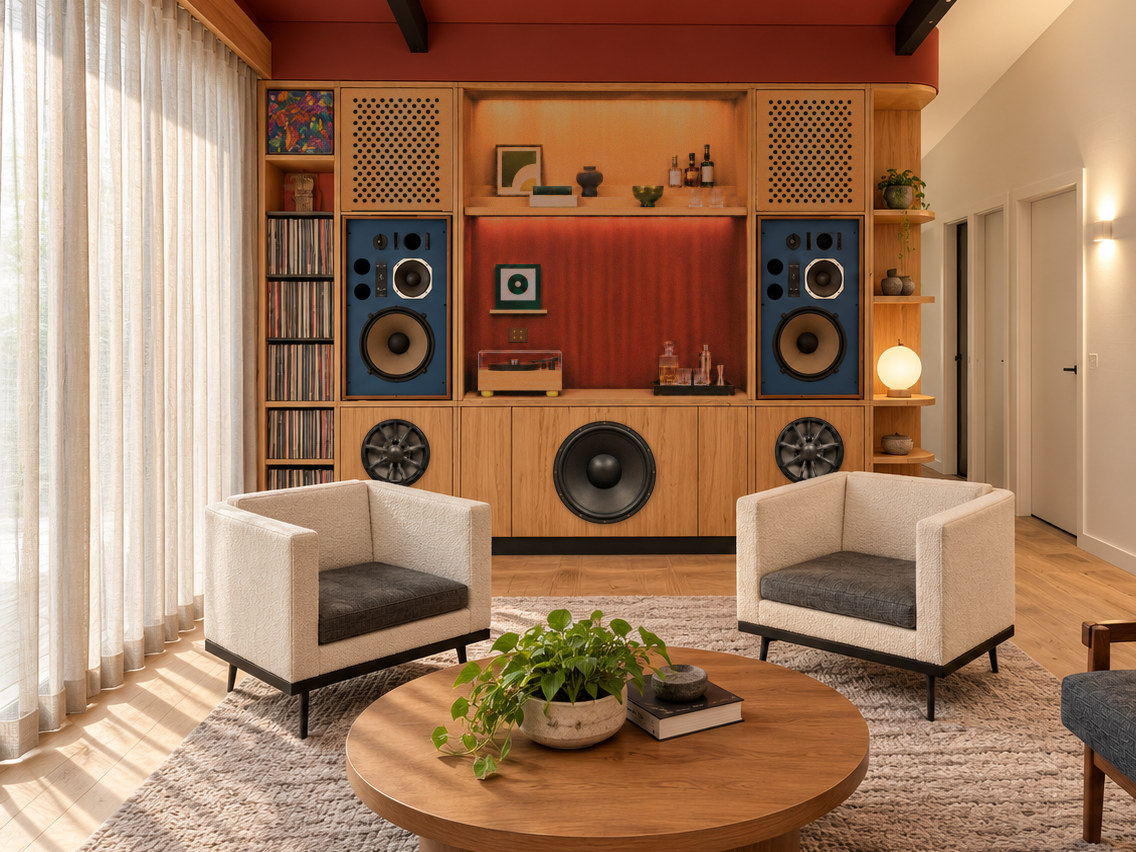
One wall holds two vintage speakers, subwoofers, a turntable, a bar and records.
Tuned to the room
Each room gets its own tuning.
The room's size and shape set up strong bass peaks and dips in fixed places, so moving a microphone even a little changes the reading. Tuning starts with measurements where people sit. At the Mornington Peninsula main seat, every speaker showed a dip between 56 and 63 Hz that no electronic fix filled cleanly.
Those measurements showed a subwoofer at the Mornington Peninsula project playing out of step with the main speakers and cancelling deep bass. Flipping its polarity lifted the worst spot from 18 decibels below the main speakers alone to about 2 below. The chart sets the speakers on their own against three tuned settings.
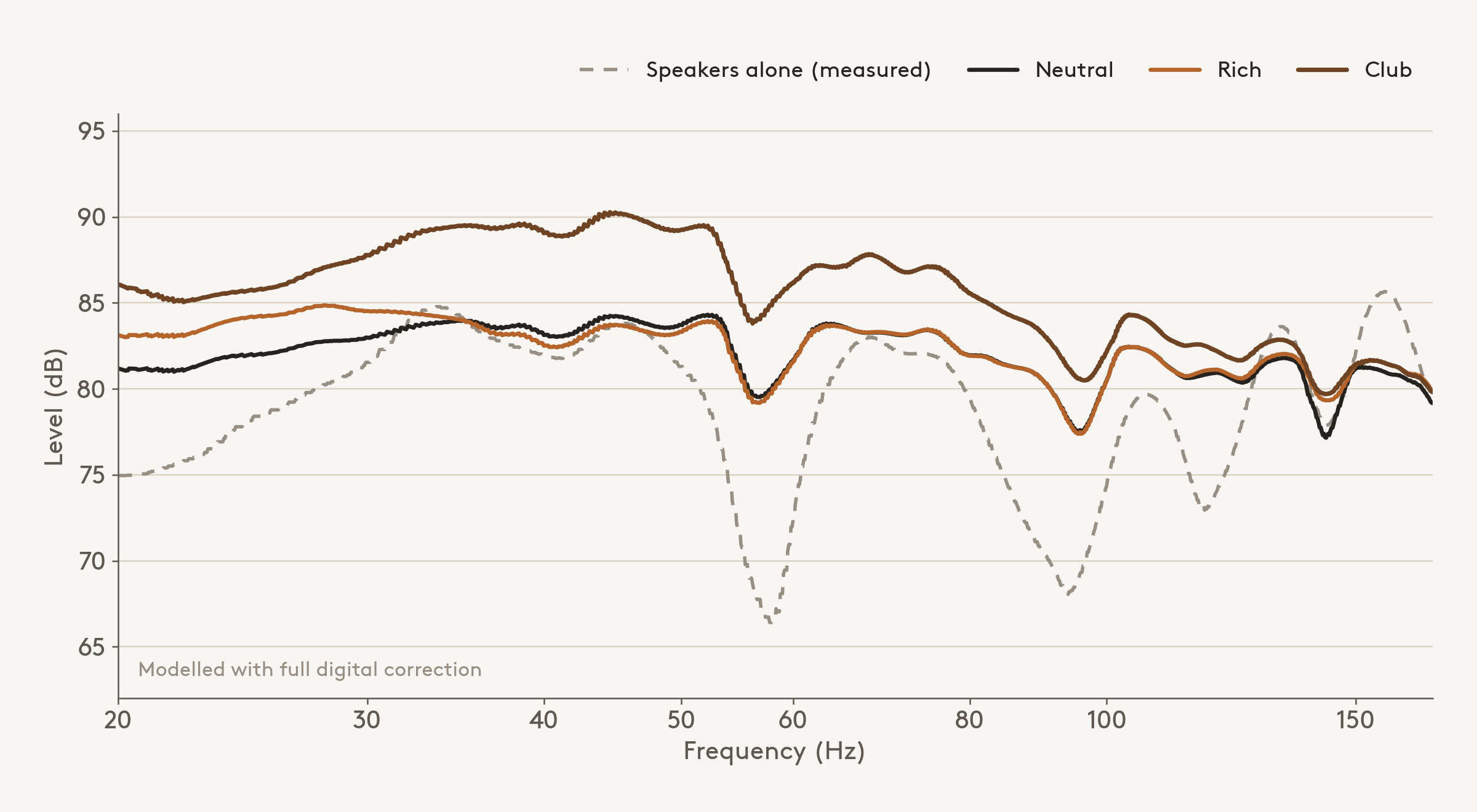
Dashed: the speakers alone, as measured. Solid: three modelled settings.
Adjusted to taste
Taste has the last word.
In published blind tests at home, the amount of bass people preferred varied by 17 dB, so one target cannot suit everyone. After tuning, the Mornington Peninsula project offers neutral, rich and club settings to switch between. Listening found the club setting too rumbly, so we reshaped its lift towards chest kick, around 80 to 125 Hz.
Our taste also guides the tuning, and it leans to a full, enveloping sound over a sharp, analytical one. One option is a valve amplifier, which strengthens the signal through glass valves, also called tubes. At the Mornington Peninsula project, valve amplifiers drove the main speakers while all three settings were measured.
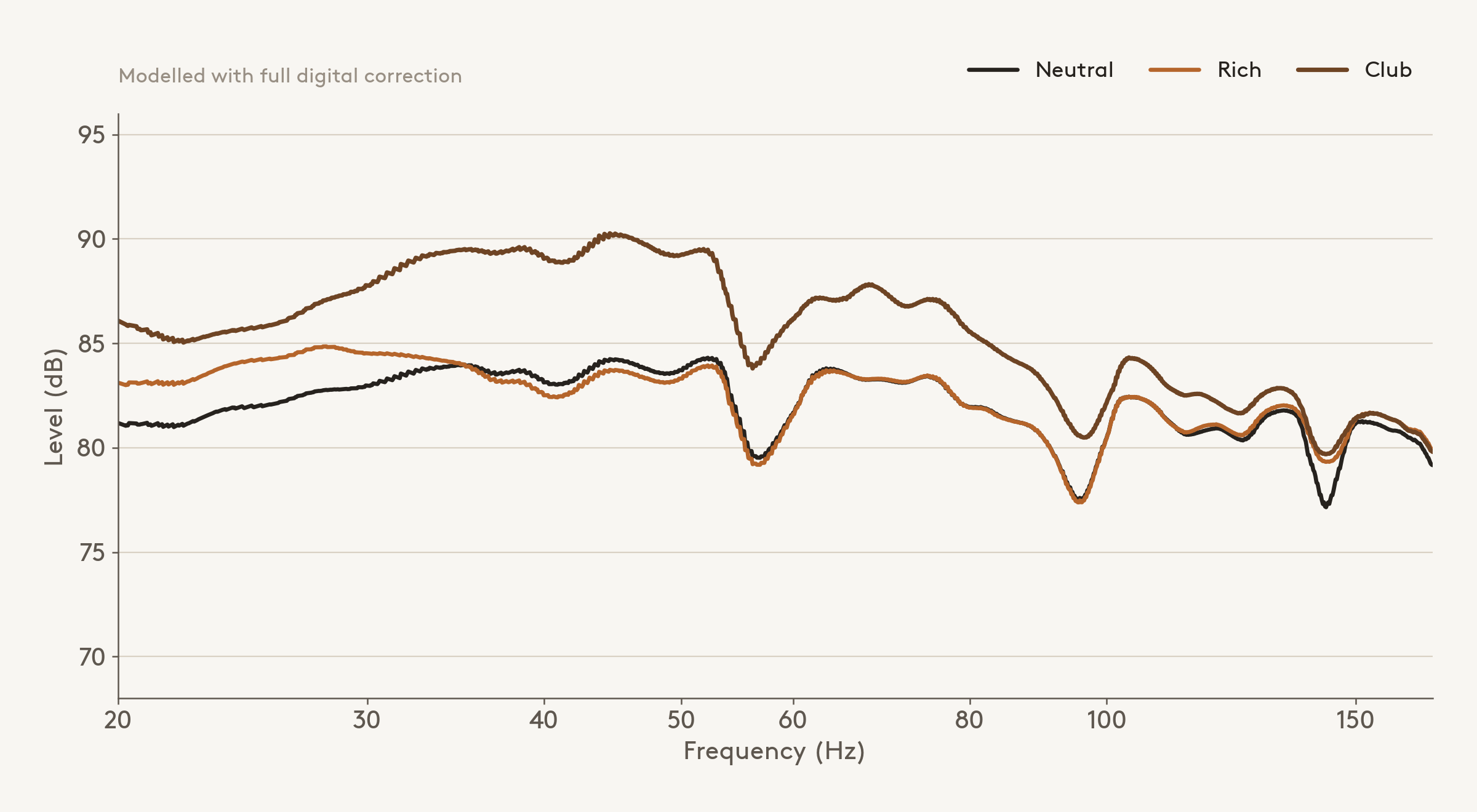
Neutral, rich and club at the main seat, modelled with full digital correction.
Quiet and loud
From conversation level to dancing.
The target is music that is engaging at conversation level and clean at dancing volume. Efficient speakers help at the quiet end, because they make more sound from each watt. At the loud end, deep bass depends on how much air the cones move. Punch from 40 to 80 Hz depends more on efficiency and amplifier power.
Contact
Begin at the drawing stage.
The speaker bays, the cable routes and the seats the sound is designed for all go into the same drawings as the joinery. So the conversation starts while the house is still on paper. We work with architects, builders and home owners in Melbourne and across Victoria.